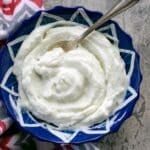
Lebanese Garlic Sauce (Toum)
Lebanese Garlic Sauce or Toum is a staple of Lebanese cuisine. It's a light, fluffy, and flavorful garlic-based sauce that can be served in a variety of ways and many different dishes.
Servings: 32 servings
Calories: 64kcal
Equipment
- 1 quart-sized, wide mouthed mason jar
Ingredients
- ½ cup peeled whole garlic cloves
- 1 teaspoon sea salt
- 3 tablespoon lemon juice
- 1 cup avocado oil
Instructions
Toum With An Immersion Blender
- Peel garlic cloves and discard skins. Slice garlic cloves in half and remove any visible germs from the center. Not all cloves have a visible germ to remove.
- Add garlic, salt, and lemon juice to a tall cylindrical container such as a quart sized wide-mouthed mason jar. Use an immersion blender to blend the ingredients until frothy.
- Pour oil into the jar all at once. Slowly lift the immersion blender up and down as you blend the oil into the other ingredients. The mixture will emulsify and get thick. It should take less than 5 minutes.
Food Processor Instructions
- Peel garlic cloves and discard the skins. Next, split each garlic clove in half lengthwise. Remove garlic germ from the center of every clove that has one. Not all cloves have a visible germ.
- Add garlic and salt to the bowl of a food processor. Blend to make a garlic paste. You will need to occasionally remove the lid and scrape the sides of the bowl with a spatula.
- With the food processor running, pour oil into the food process in a very thin, thread-like stream. Alternate with 1 teaspoon of lemon juice. Continue alternating between the two until the mixture is emulsified. Since the ingredients are being added very slowly, it will take around 20 minutes to make.
Video
Notes
- If you decide not to remove the germ, the garlic sauce will likely be spicier, somewhat similar to horseradish in taste, and might be slightly bitter.
- For a successful garlic sauce every time, start with a high-powered immersion blender or a small 3-cup food processor.
- If you decide to do a double batch, you will need a 5 or 6-cup processor instead.
- Use high-quality, fresh garlic cloves instead of minced or pre-peeled garlic.
- Lebanese garlic dip can last for months when stored in an airtight container in the fridge.
- This garlic sauce recipe will be thicker in texture if prepared in a food processor and lighter and fluffier if you use an immersion blender. That's because the longer the mixture is blended, the thicker the texture will be.
- If the emulsion breaks, see the troubleshooting tips in the post on how to fix it!
Nutrition
Serving: 1tablespoon | Calories: 64kcal | Carbohydrates: 1g | Protein: 0.1g | Fat: 7g | Sodium: 73mg | Fiber: 0.05g | Sugar: 0.1g
