

This easy fermented cabbage is tangy, crunchy, and full of live probiotics! It only takes a few ingredients and a few weeks of patience. Try it with a Reuben Sandwich on Sourdough or enjoy it as a topping on a wide variety of dishes!

Would you like to save this recipe?
This fermented cabbage is the perfect topping for sandwiches, burgers, sausages, salads, and even ramen (trust me, it's amazing). Making sauerkraut at home is also cheaper than buying it, and it tastes so much better. Many people even enjoy a spoonful or two a day.
According to Healthline's article 8 Fermented Foods and Drinks to Boost Digestion and Health, eating fermented foods like sauerkraut can boost the number of beneficial bacteria, or probiotics, in your gut. Probiotics may help with digestion and immunity.
Jump to:
🔖 Ingredients & Substitutions
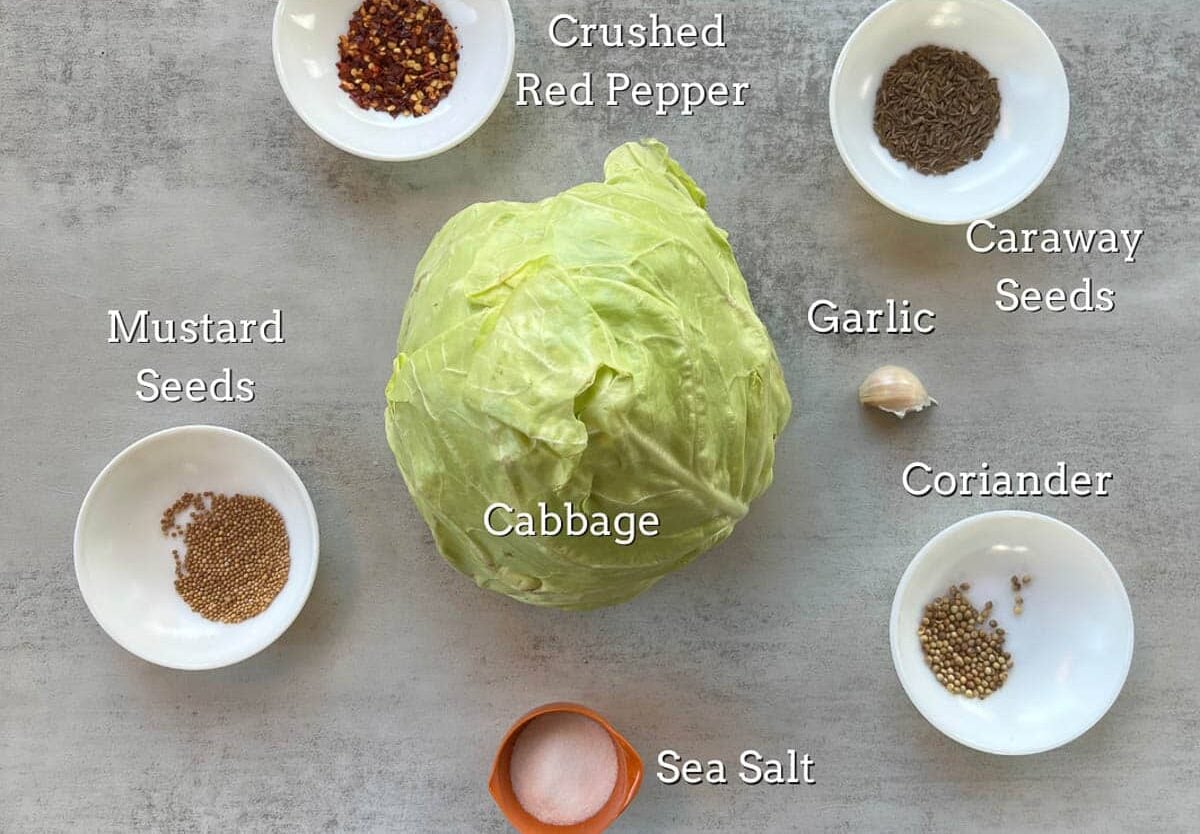
- Cabbage: I used green cabbage, but you can also make red cabbage sauerkraut with red cabbage.
- Brine: Water and sea salt. Use a non-iodized salt like sea salt, kosher salt, or pickling salt.
- Spices: Mustard seeds, coriander, caraway seeds, and crushed red pepper. You could substitute the crushed red pepper with a Serrano pepper or other fresh peppers, or leave it out entirely!
- Garlic: I love the flavor that garlic imparts to fermented cabbage. If you're not a fan, you can leave it out.
- Optional Ingredients: You can also add juniper berries, shredded carrots, and dill seed.
🥬 How To Make Fermented Cabbage
Step 1: Remove the outer leaves of the cabbage, then wash thoroughly. Next, chop the cabbage with a sharp knife and add it to a large non-metallic bowl. Add slivered garlic, spices, and 1 tablespoon of salt. Stir to combine.


Step 2: Let the cabbage sit for at least 15 minutes, then stir once more.

Pro Tip: Most fermented cabbage recipes recommend smashing the cabbage and allowing it to release its juices anywhere from 1 to 2 hours before bottling it. I've tried it both ways and found that the end result is the same.
Step 3: Pack the shredded cabbage mix into 2 sterilized, wide-mouthed 1-quart mason jars (or 4 half-pint jars) using a rubber spatula or non-metallic spoon.


Step 4: Combine 3 cups of water and the remaining 1 tablespoon of salt and stir to dissolve. Pour over the cabbage until it reaches the rim of the jar. Loosely cap the jar with a sterilized lid.


Step 5: The cabbage will begin to bubble as it ferments, so place jars on a rimmed tray or glass dish to catch the juices. Store somewhere cool (between 65 and 72 degrees F).

Pro Tip: If you have an airlock, you can use it to keep impurities out while allowing the air bubbles to escape. You can buy fermenting lids with the airlocks; however, they are not absolutely necessary!

Step 6: Every few days, look inside the jar to see if the water level has fallen below the rim. If so, top it off with more salt water, using 1 ½ teaspoon of salt for every cup of water. If the cabbage is floating to the surface, push it back down until the cabbage is submerged.


Pro Tip: If you have fermenting glass weights, they do a great job of keeping the cabbage submerged in the brine during the fermentation process. This will eliminate mold forming on the cabbage that's being exposed to oxygen.
Step 7: You can ferment your sauerkraut for 1 to 3 weeks, tasting it every few days, until the desired flavor and texture are achieved.

✅ How to Tell When It's Ready
Fermented cabbage becomes ready faster in a warm kitchen and slower in a cool one, so let your taste buds be the judge. Here's what to look for:
- Smell: It smells pleasantly sour and tangy, like sauerkraut, not like raw cabbage.
- Color: The cabbage turns from bright green to a paler, slightly see-through yellow-green.
- Texture: It's softer than raw cabbage but still has a little crunch.
- Bubbles: The bubbling slows down once most of the fermenting is done.
🍽 Serving Suggestions
Homemade sauerkraut is so much tastier than the bagged or canned kraut you can buy in stores. Add it to hot dogs or brats, or make a delicious Reuben sandwich with some smoked corned beef brisket, Swiss cheese, and fermented cabbage.
One of my favorite ways to use fermented sauerkraut is to make kielbasa and sauerkraut. Keep in mind that cooking it kills the live probiotics, so enjoy some raw, too!

🧊 How to Store Fermented Cabbage
Once your fermented cabbage tastes the way you like it, tighten the lid and move the jars to the refrigerator. The cold slows the fermentation way down, so the flavor stays where you want it. Stored in the fridge, it keeps for several months as long as the cabbage stays under the brine. Always use a clean fork or spoon to take some out.
🔍 Is It Mold or Kahm Yeast?
Don't panic if you see something on top of the brine. Here's how to tell the difference:
- Kahm yeast: A thin, flat, white or cream-colored film on the surface of the brine. It may look a little wrinkly. It's harmless, but it can affect the flavor, so skim it off and make sure the cabbage is still submerged.
- Mold: Fuzzy, raised spots that are often blue, green, black, or pink. If you see fuzzy mold, or the cabbage smells rotten or feels slimy, toss the batch to be safe.
The best way to prevent both is to keep the cabbage completely under the brine, which is why fermenting weights are so helpful.
🤷🏻♀️ Recipe FAQs
Fermented cabbage is usually called sauerkraut, which means "sour cabbage." However, there are many kinds of fermented cabbage known by many names across cultures including Korean kimchi, Haitian pikliz, and Vietnamese dua cai chua.
Fermenting cabbage takes at least one week, but it becomes more flavorful the longer it ferments. You can leave your cabbage to ferment for up to 6 weeks, although for many people 3 weeks seems to be the sweet spot.
Yes! Raw, unpasteurized fermented cabbage like this homemade version is full of live probiotics. Most shelf-stable canned or jarred sauerkraut from the store has been pasteurized or heat-processed, which kills the live bacteria. For the most probiotics, eat it raw rather than cooked.
🥒 Other Fermented & Pickled Recipes
- Jerusalem Artichoke Recipe
- Mexican Pickled Carrots
- Pink Onions
- Torshi (Assyrian Pickled Vegetables)
- Quick Pickled Red Cabbage

👩🏼🍳 Pro Tips
- Don't use metallic utensils or bowls when making fermented cabbage. The metal reacts with the acid from the cabbage, causing your sauerkraut to taste like metal.
- No fermenting weights? Set aside a clean cabbage leaf when you start and press it on top of the shredded cabbage to keep it under the brine.
- Cloudy brine and bubbles are a good sign. They mean the fermentation is working.
- Keep the jars out of direct sunlight, and write the start date on each jar so you know when to start tasting.
🌶 More Fermented Recipes



Did you make this recipe?
📖 Recipe
Would you like to save this recipe?

Ingredients
Equipment
Method
- Remove the outer leaves of the cabbage, then wash thoroughly. Next, chop the cabbage with a sharp knife and add it to a large non-metallic bowl. Add slivered garlic, spices, and 1 tablespoon of salt. Stir to combine.
- Let the cabbage sit for at least 15 minutes, then stir once more.
- Pack the shredded cabbage mix into 2 sterilized, wide-mouthed 1-quart mason jars (or 4 half-pint jars) using a rubber spatula or non-metallic spoon.
- Combine 3 cups of water with the remaining 1 tablespoon of salt and stir to dissolve. Pour over the cabbage until it reaches the rim of the jar. Loosely cap the jar with a sterilized lid.
- The cabbage will begin to bubble as it ferments, so place jars on a rimmed tray or glass dish to catch the juices. Store somewhere cool (between 65 and 72 degrees F).
- Every few days, look inside the jar to see if the water level has fallen below the rim. If so, top it off with more salt water, using 1 ½ teaspoons of salt for every cup of water. If the cabbage is floating to the surface, push it back down until the cabbage is submerged.
- You can ferment your sauerkraut for 1 to 3 weeks, tasting it every few days, until the desired flavor and texture is achieved.
Nutrition
Video
Notes
- Most fermented cabbage recipes recommend smashing the cabbage and allowing it to release its juices for 1-2 hours before bottling, but I've tried it both ways, and the end result is the same.
- If you have fermenting glass weights, use them. They do an excellent job of keeping the cabbage submerged in the liquid and not exposed to oxygen as it ferments.
- If you have an airlock, you can use it to keep impurities out while allowing the air bubbles to escape. You can buy fermenting lids with airlocks, however, they are not absolutely necessary!
- Don't use metallic utensils or bowls when making fermented cabbage. The metal reacts with the acid from the cabbage, causing your sauerkraut to taste like metal.
- If you don't own fermenting weights, set aside a cabbage leaf when you first start. Once the shredded cabbage is bottled, place the reserved cabbage leaf on top to keep the cabbage from floating to the surface.
- You can use this recipe to make red cabbage sauerkraut by swapping purple cabbage for the green cabbage.
Jessica says
How long does it keep in the fridge? Thank you!
Hilda Sterner says
Hi Jessica, I've had a jar in the fridge last 2 months. It would probably last even longer, but we usually eat it within a month or two.
Kay says
First time trying this. I have about 1 inch of brine mixture above the level of cabbage which is held down by fermenting weights. The water level rose as it sat on the counter slightly covered for 5 days. Do I put it in the refrigerator now for a couple more weeks covered or uncovered or leave on the counter slightly covered. The brine flavor is very tasty according to my husband who grew up eating this. Looking forward to the enjoying this soon. Thank you
Hilda Sterner says
Hi Kay,
I'm not sure if you saw the last step in the recipe card, but if so, it says: "You can ferment your sauerkraut for 1 to 3 weeks, tasting it every few days, until the desired flavor and texture is achieved." After that, you would cap it and store it in the fridge. I hope you and your hubby enjoy it!
Jeremy says
Good stuff. It is an acquired taste but well worth it.
C. Andersen says
Do I tighten the lids and refrigerate the cabbage after the fermentation process is complete?
Hilda Sterner says
Hi, Yes, you can either process them for longer storage or refrigerate!
Ruby says
excellent.
Hilda Sterner says
Thank you, Ruby!
Marce says
"You can ferment your sauerkraut for 1 to 3 weeks, tasting it every few days, until the desired flavor and texture is achieved."
What do you do with it once it's ready? Do you store it in a separate jar?
Hilda Sterner says
Hi Marce, No, you don't need to store it in a separate jar. Keep it in the same jar and refrigerate or process in hot water canner for longer storage.
Cheryl Krumrine says
This was my first try at sauerkraut. It is the best I've ever had. It's now in my permanent collection. I have no need for a different recipe. Thanks so much!
Hilda Sterner says
Thanks, Cheryl, it's our favorite too. Thank you for the review!:)
Cheryl krumrine says
This was my first attempt at making sauerkraut. It was the best I've ever tasted. I cannot imagine making a different recipe. The seasonings made it extraordinary!
Hilda Sterner says
Hi Cheryl, Wow, thank you so much! I'm glad you enjoyed it as much as we do.
FoodJunkie says
A nice straightforward recipe for one of my favourite foods. How much would you consider to be in one serving?
Hilda Sterner says
Hi,
One serving is 1/4 cup. Thank you so much for the review!
Beni says
An easy recipe for healthy sauerkraut. I like the suggestions of how to incorporate it in your meals. Thanks!!
Hilda Sterner says
Thank you, I hope you enjoy it, it's so good for you!